Tuesday, October 20, 2009

Alexandria continued


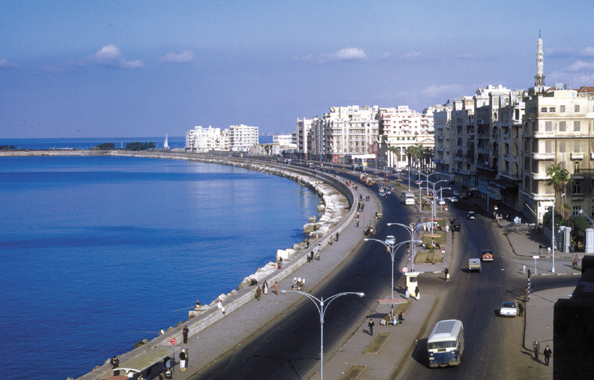
There are a handful of cities around the world that can be said to have one foot in the past, the other in the present. Similarly, many of these cities are both apart of their country and yet at the same time are really not. Alexandria is one of those cities. Situated on the Mediterranean coast, it looks longingly out towards the sea, almost as if to say, "Take me... I want to make my own destiny."

This city has quite the history, as I learned from yesterday's tour of the Bibliotheca Alexandrina, a modern version of the Alexandria Library, the intellectual center of the ancient world. The city has changed hands numerous times: Greek, Arab, Turkish, French... all have had a piece of it and have contributed something to its history. The early 20th century saw it flourish as the center of many of Egypt's ex-pat communities, namely Greeks, Italians, and Jews. Their business-savy ways brought a lot of investment to the city and transformed it into a European-style oasis in the heart of the Middle East. Alas, after Nasser came to power and nationalized most of Egypt's businesses, many of the ex-pat communities decided not to stick around.

Today Alexandria is a shadow of its former self. There are still remnants of the old days. French cafes along the sea, the occasional Greek restaurant, or Italian bakery, but nothing worth gushing over anymore. It's as if time stopped at about 1960 while erosion still took its course, giving the city a ghost-town feel.

Hopefully one day the clock will start ticking again.

Sunday, October 18, 2009

Alexandria

Sorry to all for not being very consistent with my blogging lately. Between getting sick, internet access going in and out, and traveling to Alexandria, I haven't had much time or opportunities to write (in fact my clock is ticking right now at the Internet cafe). In brief though, Alexandria is really cool and the library is totally sweet. Definitely worth checking out.

Hopefully I can get some more thoughts and pictures up soon.

Saturday, October 17, 2009

Tuesday, October 13, 2009

Trade-offs

Today I resolved to find some good fresh fruit, the intake of which I have been sorely neglecting of late. When I stopped at a decent looking shop to survey the selection, the shopkeeper bade me be seated with him outside for a moment after exchanging a couple of typical Arabic formalities. After speaking to me in rapid Egyptian, I apologized and told him I was actually not a native of this land so he should try to speak slower. He asked me where I was from and I said America.

"Oh, I lived in New Jersey for many years," he told me.

"Really? What made you come back to Egypt?"

"It wasn't my choice, I had visa issues. I hope to God I can get a new visa to go back."

I was suddenly interested in why he was so anxious to get back to the U.S. He seemed like he was making a decent enough living here: nice, full produce shop right in downtown Cairo with a couple of workers to help him out.

"I love America more than here. Much more than here."

I asked him why.

"In America, if you work hard, you have a good life. It's a much better life than here. If you work hard in America, your boss says "good job" and gives you good money. Here in Egypt, you can work very hard and not make any money. You can work your whole life and have nothing."

I told him that there must be some good things about Egypt.

"The only good thing is I can do this. I can sit outside here and talk to you and nobody cares. In America, this would be like a "part-time" job," he said with a laugh. I asked him to elaborate further.

"The pace of life here is slower. People spend more time just talking and getting to know each other. It's not like work work work all the time. But it's still a hard life. America is an easy life, in my opinion."

After buying up his store and bidding him farewell, I began reflecting on the differences between the pace of life here and back home. I've definitely had my moments here where I've gotten a bit peeved at not being served quickly at a restaurant or having to wait too long to get my change because the cashier is busy chit-chatting with his buddy behind the counter. The pace of life here is different, but people are more social and do indeed take the time to get to know each other. Building friendship and trust is a very important part of Arab culture (especially business culture). It's not just like "trust me"... no, no. Let's have tea or coffee and smoke some shisha first. Let's chat a little about religion or politics or each other's family. This is how things work here. America--at least the northeast--is a long way off. People keep more to themselves, aren't interested in others, just want to get in and get out and go home.

I'm not trying to advocate one lifestyle or another. I think there are merits to both and we should try to achieve some measure of moderation: excess of chit-chat and lounging on the job is bad, but not knowing who your neighbors or co-workers are is just as bad.

Perhaps some day we'll achieve the "perfectly balanced culture": one where well-paid work is done efficiently enough that we still have enough time left over for ourselves and for one another.

One can hope anyway.

Monday, October 12, 2009

Let my people go


Egypt's Jews--now rumored to be no more than one hundred in number--are very likely the oldest community outside of Israel. After Moses led the Jews out of Egypt, many returned to this ancient land centuries later to escape persecution in Europe. Interestingly enough, at one point compared to Europe, the Islamic world was a much better option for religious minorities like the Jews. While there were still restrictions on their political rights, they were more or less free to practice their faith. They were even exempt from many taxes which gave them some considerable advantages establishing trade and commerce.

All this changed in 1948 with the formation of the state of Israel. Egypt's Jews were harassed and even killed by angry mobs, some of which were incited by the Muslim Brotherhood. With Gamal Abdel Nasser's coup in 1952, full-out anti-Zionism became the order of the day. The pivotal point was probably the 1956 Suez Crisis. Nasser's government issued a statement saying that "all Jews are Zionists and enemies of the state" and promised that they would soon be expelled. By the end of the 1967 war, almost the entire Egyptian Jewish community had emigrated elsewhere, either to Israel, Europe, South America, or the United States.

Today I passed by the only functioning synagogue in Cairo, called Shaar Hashamayim on Adly Street downtown (shown above). By "functioning" we're talking about it only being open for the high holidays: Rosh Hashanah and Yom Kippur. Outside the temple were about a half dozen heavily armed policemen, one of whom waved me off after I snapped a picture (top left... not good quality but you can make out the Star of David above the front entrance). I guess they are afraid of Muslim radicals attempting to eradicate what's left of Egypt's all but defunct Jewish community. Sad.

There are divisions though among Jews about whether or not it is worth maintaining historical sites like the Shaar Hashamayim temple. Some say it is absolutely worth preserving Egypt's Jewish history, as Egyptian Jews contributed greatly over the years to Egypt's cultural, political, and economic vibrancy. Others say that the home of the Jews always has and always will be Israel and that they have only really been visitors of other countries... never citizens.

Nonetheless, the Shaar Hashamayim synagogue still stands at the ready, looking like it's waiting to breath easy once again.

Sunday, October 11, 2009

On poverty and fundamentalism

I think any Western traveler to the developing world will at some point experience that humbling moment when you realize how blessed you are to have the kind of standard of living that you do. I'm pretty sure I had that moment today.

I decided to venture back into Islamic Cairo and the Khan el-Khalili (bazaar) area, this time during the day, hoping to check out the Museum of Islamic Art. To my disappointment, the museum was closed for renovations. Determined not to waste another cab fare back downtown, I decided to walk in the direction of the bazaar towards the Ataba metro station. I noticed a Western-looking (Spanish) couple checking out a map, so I struck up a conversation with them and we all headed into the bazaar together. So I struck out on the museum... why should I let that ruin my day? There's plenty to see in Khan el-Khalili: street vendors and coffee/shisha houses (known as ahwas) galore, all confined within a narrow maze of winding alleyways bordered by grandiose medieval mosques. It's a little like stepping back in time, except I'm pretty sure they didn't have racks of Casio watches in the Middle Ages.

After making our way through the main bazaar, avoiding all kinds of rabble trying to push jewelry on us ("the best in Egypt, my friend!"), we emptied out onto a long stretch of road I didn't recognize. It became pretty clear to me right away that this was not where tourists normally venture. In the bazaar you see your fair share of pale-skinned backpackers trying to untangle themselves from the salesmen, but this stretch of road looked like where "the Egyptians" live. We walked down a bit until we got hungry, and to my surprise the people at the restaurant we stopped at barely spoke a lick of English.

After leaving the restaurant--which I'm pretty sure overcharged us--the three of us decided to keep exploring this new road on the periphery of the bazaar. As we walked further and further, I felt myself with every block getting further and further from civilization (or maybe, in this part of the world, it was just the opposite). The trash piles seemed to get bigger and the clothes more raggedy. The buildings looked like they would collapse at the slightest breeze. The smell of sewage and rotting food was overpowering at times. We saw fewer and fewer cars with a proper exhaust or muffler system--in fact, there were almost as many donkey-drawn carriages as cars at this point. We had reached the Third World.

I must admit as an American that has grown up in the predominantly affluent northeast, this environment was quite a shock to my system. Do people really live like this? How can they? Doesn't this abject poverty just drive them insane? I guess they figure they have no other choice and that this is what God has destined for them. Humans are adaptable beings, but they still have dignity. Even animals live better than this.

I began to think of some of the causes of underdevelopment. Egypt is a poor country, yes, but what about all that aid the U.S. supposedly gives it? Then I began to think about all those nice government buildings and those nice clean cut policemen and soldiers with their shiny rifles and crisp uniforms that guard them. Could that be where all the money is going?

Arab countries, sadly, have a very poor record of investing in their people. Economic development usually takes a backseat to military spending, as most of these autocratic regimes feel it is better to build a fortress around their authority than to actually address the root causes of challenges to it. The government considers the rise in religious fundamentalism a threat, but could it be possible that the people's shift towards it is more a response to their economic condition than to the promptings of their soul? When you don't have much, it's easy for the void to be filled by promises of paradise in the next life. You see what I'm getting at here.

I know that there are some that scoff at this poverty = fundamentalism/terrorism theory. Bin Laden is a multi-millionaire after all, they say. And it's true that the vast majority of poor Muslims don't turn to terrorism as an outlet for their frustration. But it only makes sense that the less you have, the less you also have to lose. Illiteracy goes along with poverty as well, so if the cleric tells you the Qur'an says A, there is no way you can argue that it actually says B. You don't have a fighting chance.

"Where is the Arabs' dignity?" asked Muammar Gaddafi at the annual Arab summit last year. "Their future? Their very existence? Everything has disappeared."

To be replaced by what?

The Yacoubian Building


My original hostel had some overbooking issues this week so they decided to move me to another location owned by the same family. The location happens to be on the 4th floor of the Yacoubian Building, a little piece of Cairo history idolized in Alaa al-Aswany's famous novel of the same name. For those of you who haven't read it, it's a great depiction of modern Egyptian social life and the dichotomies imbedded within it: the disparity between rich and poor, religious and non-religious, adopted Western culture and Middle Eastern culture, and so on. By tracing the lives and struggles of a diverse spectrum of Egyptian citizenry, it talks a lot about Egypt's overall failure to provide opportunities for its people to live full lives. Even the rich--who were the original inhabitants of the Yacoubian Building in the 20s and 30s--reminisce about the old days when Egypt actually had something going for it (in their view at least).

Anyway, it's a great read (trust me, I'm very picky). If you want a book that gives a really good insight into what contemporary Arab society--with all its complexities-- is all about, I would say look no further.

Friday, October 9, 2009

Sounds good, but...

As some of you may or may not know, Cairo is home of the Arab League, a regional organization of Arab states the main goal of which is, according to Wikipedia, to "draw closer the relations between member States and coordinate collaboration between them, to safeguard their independence and sovereignty, and to consider in a general way the affairs and interests of the Arab countries." My friend and I were walking by the headquarters (it was kind of one of those "oh, there's the Arab League" moments) and it began an interesting conversation about unity and the elusiveness of it. Arabs have talked about unity between their various states for a long time, whether through a secular/nationalistic or Islamic framework. The idea of pan-Arabism was very popular in Egypt in the 50s under Gamal Abdel Nasser--that is, all Arab states should be united by their common language and culture in sort of a utopian socialist brotherhood. Sounded pretty good at the time, but a series of defeats by Israel kind of discredited Nasser and put that idea on hold. Then came the Islamists, who are still slowly gaining momentum in a lot of Arab countries. Their goal is basically to undermine the region's secular regimes and eventually replace them with a resurrected Islamic caliphate, reminiscent of the "good old days" when Islam more or less united everyone in the region, whether it was under the Abbasids or the Ottomans. This idea is popular among some who feel a renewed pull towards religion, but not enough to really challenge the status quo.

In short, Arab unity has been elusive. The Arab League has probably had the most success bringing Arabs together to condemn Israel than achieving any measure of regional integration. My friend made a very thought-provoking comment to this effect:

"I find it confusing and a bit sad that a continent like Europe--with all its various languages, cultures, and religions--can come together and form such a wonderful organization like the European Union and we Arabs--who actually share a common language, culture, and religion--somehow can't find it in us to unite in any tangible way."

Yeah, what's up with that.

Thursday, October 8, 2009

Story of an angry mullah

My friend and I spent the evening strolling about Islamic Cairo, admiring the medieval architecture while trying not to get hassled too much in the bazaar (which to my surprise actually had some decent stuff). We passed by a bunch of amazing looking mosques, some of which you can check out below. We stopped at one that still had a group of people praying the isha'a (night) prayer. I peered inside for a minute as the row of worshippers prostrated themselves in unison.

"Take off your shoes, let's go inside," my friend said.

"What? Seriously?" Being a Baha'i, I was afraid of stepping foot inside a mosque being "used".

"Yeah, it's fine. Just don't look at the doorman." Clutching my shoes in one hand, I hurried in after him. Even though I tried my best not to make eye contact, the doorman noticed us anyway. He started getting frantic as we kept walking towards the row of worshippers.

"Ustaaz! Ustaaz!" (mister! mister!) he shouted after us. I tried not to look back.

"Just keep walking," my friend said.

"USTAAZ!" I heard him call out something to the mullah-on-duty. Oh, crap. This bearded guy dressed in white managed to intercept us before we got to the main prayer area.

"HEY! YOU! STOP! Where do you think you're going?"

"I just wanted to show my friend the mosque," my friend said insistently.

"No, absolutely not! This is prayer time! This place is not a tourist attraction!"

"Yes, but it's a house of God. Why can't we go in?"

"Absolutely not! Leave! Get out!" The mullah's face was red. Seriously pissed. My friend stood his ground, completely composed. I was quite impressed.

"Sir... don't you, as a good Muslim, think it would be better to give an outsider a good impression of Islam? Instead of kicking him out like this?"

The mullah looked like he was about to yell something else but my friend's sound reasoning literally stopped him in his tracks. He went dead silent and then waved us off, storming away still visibly fuming from the exchange.

I couldn't believe what had just happened. I had this image in my head of the argument getting more and more intense until the mullah was forced to get the Muslim Brothers on the horn and we would have had to fight our way out (I guess I watch too many movies). But all it took was a calmly delivered point of reason that sent the angry mullah packing. Great stuff. If only U.S. foreign policy were so effective...

Islamic Cairo, Ataba, and Khan el-Khalili


Wednesday, October 7, 2009

Money money money

A friend of mine back home told me that while in Egypt I should try to keep track of the number of crazy fatwas coming out of al-Azhar University. However instead I think I'm going to start keeping track of the number of times I get ripped off or people attempt to rip me off.

I counted a solid four times today. The first time I was on my way to the Egyptian Museum of Antiquities (I'm not so into antiquities but it's just one of those "must-see" places in Cairo) and this guy caught me as I was about to cross the street. I must admit I did kind of stick out today with my Boston Red Sox t-shirt. Anyway, he goes, "Oh, you're going to the museum? Don't go now." I asked why. "Because now is when all the tours go. You should wait half an hour." I was skeptical, but told him thank you anyway and kept walking. He didn't leave me alone.

"So, you're from America?"

"Yes," I said, not really in the mood to talk.

"I have a friend in Seattle. Have you been there?" (Pretty much everyone I've met in Egypt has a 'friend in America'.)

"Yeah, I've been there." I kept walking towards the museum.

"Man, I'm telling you, don't go there now. They close at 7 anyway. You have time."

"Well, I have to meet someone in a couple of hours so I want to go now."

"Listen, man, really, don't waste your money there. They charge extra if you're American. Come with me and I'll show you a place where you can buy at Egyptian prices. Come, come I'll show you."

"No. No, thanks." I managed to brush him off after another minute. The funny thing is I looked back and saw him literally reverse direction at the point where I had met him, which means it's clear he was only interested in getting me to go somewhere with him from the very beginning. Strike one.

Then once I got past all the security at the front entrance of the museum, this older man walked up to me trying to get me to pay him to give me a tour of the museum. Strike two.

"No, it's okay," I told him in Arabic. "I want to go by myself."

"Okay. You speak Arabic well. I hope they give you a good price because you know they charge a much lower price for Egyptians."

"Yeah, I heard that."

"But the trick is you have to prove it. Good luck."

I worked my way through the crowd to the ticket counter.

"One, please," I said in Arabic. I handed him a 10-pound note, hoping to get away with paying the Egyptian price. The ticket agent was distracted for a moment and was about to take my note when he stopped.

"Where are you from?" he asked. Shoot. I shan't tell a lie.

"America."

"60 pounds."

I wasn't about to let him get me that easily. I did my best angry Arab impression.

"Come on, man! I'm half-Arab! I'm one of you! I thought Egyptians were nice people! How can you rip me off like this?"

"60 pounds. Six-ty."

I tried a little more but he wouldn't budge. He just kept his hand outstretched repeating "six-ty." I finally gave in. But I continued to make a scene even afterwards to the crowd of Arab tourists behind me. "Can you believe that? What a mushkeelah (problem)!" I heard a guy in line repeat it. "Yeah, mushkeelah indeed!" Strike three. My blood was beginning to boil a little bit considering I had had to shake off three money scams in just the past 15 minutes.

Once inside the museum, I was disappointed to discover that barely any of the pieces had information cards assigned to them. What kind of a museum doesn't tell its visitors about its pieces? My best guess is that they don't believe in the concept of "self-guided tours." God forbid. No, it's better if we cough up even more money to get a guide, hence the encounter outside the ticket counter. Sigh.

And finally, I think my strangest money scam experience thus far to date was the one I had in the museum restroom. As I saw the sign and entered the room, a guy standing there essentially "ushered" me to the urinal. "Yes, men's room, here you are," he said with an outstretched hand welcoming me to relieve myself. I immediately knew what was going on and felt the hair stand up on the back of my neck. The guy stuck with me like glue... I caught him out of the corner of my eye standing only a couple of feet behind me as I took care of business. Then as soon as I was done, he tapped me and said, "Yes, over here to the sink. Over here." What am I an idiot? I continue to ignore him. As I got to the sink and turned on the water, he picked up the bottle of soap and tries to squeeze it all over my hands. That's when I stopped him. "No, no, thank you. Please let me do it." I scrubbed quickly, eager to get out of there. I backed away from the sink and made my way towards the exit, when one last time he tried to intercept me, this time with a couple squares of paper towel in his hand.

"Here, dry your hands, here."

"No, I'm fine, thank you."

"Change?" I noticed a couple of coins in his other hand.

"No." Strike four.

Alright, enough story-telling. I think the point here is that I've found in Egypt thus far that it is really really hard to tell when someone is trying to be sincerely helpful or not. It seems that most of the time the person is in it for the money. Which is sad because trust is what makes the world go 'round. If we are always trying to scam each other, it's going to breed more and more mistrust and animosity until we reach a breaking point. I'm actually getting a little sad just thinking about how much less friendly I've had to become just to shake off all the scammers and disingenuous people I run into on the street. Just the mere fact that I had to pay a higher price for the museum for being a "foreigner" makes me mad. They may consider it a matter of fact, but I call it pretty shameless discrimination.

Welcome to Egypt, I guess.
Tuesday, October 6, 2009

Old Cairo: Islamic edition


Old Cairo: Christian edition


Egyptian cleric wants to ban the niqab


My buddy Brad sent along a short article from the BBC that, after today, I felt the need to comment on. For once in my life--and it still kills me to say this--I am completely supportive of something coming out of al-Azhar. I was just walking along the Nile today and saw at least a half-dozen of these "munaqabat" strolling along with their husbands and kids. A couple of people here that I've spoken to say that, essentially, this is all coming from the Wahhabis in Saudi Arabia. Muslims go on hajj to Mecca and see the women there in niqab and think or are told that this is somehow the Islamic thing to do. It just goes to show how influential the Saudi Wahhabi establishment has really become in the Muslim world, especially when traditionally Egypt has been one of the more "liberal" Arab states. Yeesh.

Monday, October 5, 2009

Culture blending: one Egyptian's view

So a friend of mine here in Cairo invited me to go with him to a concert of sorts in Zamalek, a neighborhood on the west bank of the Nile. The band that was playing was very young, made up of boy-band heartthrob types doing sort of a pop rock/funk fusion with romantic Arabic lyrics. They were quite good actually. Their passion for their lyrics thoroughly succeeded in swooning their audience, which included more than a couple of excited female fans. Judging from the presence of some local news media, my friend expressed his belief that they are "up and coming" on the contemporary Egyptian music scene.

But other than a few catchy melodies I had a hard time drilling out of my head, I took away from the concert a very lively conversation I ended up having with a fairly young guy sitting next to me. Somehow detecting my Americanness (those Egyptians have a way), he asked me what I, as an American, thought of the band. I said I thought they were pretty good. And you?

"Honestly," he says, "these guys are not Egyptian to me." I ask why he says that.

"Look at how they dress, how they play... these guys are an American copy. This is not Egyptian culture. This is American culture done by Egyptian boys."

I asked him what he meant by Egyptian culture, like traditional Arabic music? He said, "Well, here we have our traditional Islamic culture. We have our Islamic way of life. This should be separate from American culture, in my opinion."

I asked him, "Okay, but what do you mean by Islamic culture? I thought Islam was a religion."

"Yes, it is a religion," he says, "but it has a culture that does not go with American culture."

I said, "Okay, but what's wrong with appreciating both cultures?" He said, "Nothing wrong, but they should be separate."

"Okay, fine. So then you don't like these guys, I guess?"

"No, not just not like. They make me sad. Very sad."

I said I was sorry to hear that. But I assured him, as an authority on American pop culture, that these guys still maintained a very Arab taste to their style. Needless to say, he seemed less than willing to accept my opinion. Oh well.

So what's the point here? Well, I definitely think this conversation hits on some of these "food-for-thought" questions I wrote in my first entry. Are Western values and Islamic values compatible or able to be harmonized? Well, now we know at least one proud Egyptian Muslim doesn't quite think so. But even more than that, it became clear to me from that conversation that there is this existing notion that somehow "Islamic culture" is--or should be--synonymous with Egyptian culture. If you are going to claim to be Egyptian, you need to uphold that "Islamic culture" or risk being ridiculed or considered unauthentic, at least by the older generation. But honestly, this guy I was talking to wasn't that old... I would say probably early to mid-30s. So is it possible that in a few years even people in their 20s will be talking the same way? Or will they always turn to America and the West for their cultural inspiration?

I guess we'll have to wait and see.

Sunday, October 4, 2009

A new, hip trend in Islam?

I apologize in advance if you guys get tired of hearing me talk about religion here in Egypt... but man, it's really everywhere. I don't know, maybe it's like this in the southern United States with regards to Christianity (somehow I doubt it), but it's like every restaurant or shop I go into with a TV, there is a mullah talking about some aspect of Islamic theology or just giving some kind of "practical" spiritual advice like, for example, "doing righteous deeds will save you from hellfire." Yeah, thanks.

Today though, I saw something particularly interesting. There was a channel showing a much younger, clean-shaven guy dressed in Western-style clothing talking about how we should pray that our deceased relatives are living pleasant afterlives and that they are close to God. I found myself strangely delighted by him as I ate my kebabs and tahini. His outward appearance--young, non-bearded, hip sideburns, wearing a striped polo shirt and stylish denim jeans--struck me as out-of-the-ordinary for a "mullah". He also wore a smile--something not common for your typical bearded sheikh-- as he spoke about the important of prayer, praising God as he wished that everyone's deceased relatives were enjoying the afterlife.

I had to say that I was a bit surprised that someone that young and that "Western" in appearance (not to say that all religious Arabs look like the Taliban) had seemingly such a reasonable and penetrating perspective on spirituality. And his talk wasn't the fiery poisonous rhetoric about infidels or whatever the stuff that we in the West normally hear coming out of the Muslim world. It was just plain and simple spiritual advice shared in a loving manner. It made me wonder if maybe this trend will continue-- getting back to the spiritual "basics" of religion rather than the divisive, man-made politics-dressed-as-religion rubbish that is so often focused on by Middle East scholars in the West.

Or maybe this is an observation that should be considered in isolation. Maybe he's just one guy that is trying to buck the trend. Or maybe he was just having an "off" day from his usual tirade against the Jews. Who knows.

But anyway, it was cool to see that walking out of that restaurant as the call to prayer sounded for the last time today.

And more...


Backed by popular demand...


Saturday, October 3, 2009

First impressions

It's really hard to do justice to Cairo in writing. It's such an overwhelming environment to an outsider that it's hard to know where to begin. I can say though that my first day here in what might as well be the mother city of the Middle East included pretty much all the common stereotypes about its people and how they behave.

Before getting into that, I want to go back to my research questions and dichotomies, if you will. First of all, this IS a religious society. No question. Washing up this morning in the bathroom I was startled to hear a loud speaker outside calling people to prayer. One after another after another, the muezzins (prayer callers) all around started up with their chant. Different melodies all proclaiming the same message: God is Great, there is no god but Him, Mohammed is His Prophet, come and worship. I had heard that piety had become an "in" thing in Egypt and whoever told me that was definitely right. The word "Allah" (Arabic for God) is used so much just in ordinary conversation that sometimes--for a Westerner at least--it feels exhausting trying to keep up. "God bless you", "God protect you", "if God wills", "praise God", "only God knows". It's hard to know whether people are being sincere or if they are just saying it, but either way it's very much a part of Egyptian colloquial. Even on buildings and shops, one can see engravings or signs with God's Name proclaimed in different forms, whether it's a simple "Bism Allah" (in the name of God), or the entire Shahaddah (Muslim testimony of faith) written out in Arabic calligraphy, so that, I'm assuming, no one will doubt the shopkeeper's devotion. It doesn't hurt to have religiously-themed music blaring in your shop as well, something that I heard quite a bit just strolling through the alley ways.

One more thing about public displays of piety: the "zabibah". I really had a hard time believing this was true before I came here. I had read some article saying that more and more Egyptians these days were sporting a zabibah, which is basically an enlarged purple bump on one's forehead that is supposed to symbolize the frequency of one's prostrations on a prayer rug. Not sure whether people really get it from prayer or if it's created artificially (probably both), but in any case it is quite a sight to behold so many men of all ages with this very visible bump on their forehead. It's almost as if to say, "Don't think about opening your mouth to judge me, for I am clearly a religious man."

Oh, and of course, I've already been asked more times than I can count: "Are you Muslim?" And then when I indicate a negative, I get an "it's okay"... like as if I've completely missed the boat somehow but one day, with God's help, I'll get on it.

More thoughts--and pictures--soon.

Friday, October 2, 2009

Ahlan wa sahlan bikum

Welcome to my blog. Funny title, I know, thank you. I think it does the job.

Seriously though... I've been trying to think about what the purpose of this space will be. Before departing for the Middle East, more than one person said that I had to start a blog. But a blog about what exactly? The first thought that came to mind was a bunch of pictures of me standing next to pyramids with witty captions underneath. That's so cliche though, isn't it?

Being the nerd that I am, I came up with a series of "research questions" that I want to explore during my time in the region. Actually, they are not so much questions as comparisons and--what I expect to be--distinctions that I want to draw between Arab/Muslim society and that of the West.

And now for your intellectual enjoyment, here is the list I've come up with so far...


Western values vs. Islamic values: questions and comparisons


-individualism vs. collectivism


-secular society vs. religious society


-separation of church and state vs. integration of church and state


-man's will vs. God's will


-religious tolerance vs. religious conformity


-liberty vs. submission


-progressive religion vs. traditional religion


-career vs. family


Is there a "clash of civilizations"? Are Western values and Islamic values compatible? Can there be a hybrid? Can the West adopt some Islamic values and Islam adopt some Western values? Or are they mutually exclusive?


Until next time, inshallah.